1. Matulview
The Waveshare ESP32-S3 7inch Capacitive Touch Screen Development Board is a high-performance microcontroller board designed for various applications. It integrates a 7-inch capacitive touch LCD with an 800x480 resolution and 65K RGB colors. Powered by an Xtensa 32-bit LX7 dual-core processor running up to 240MHz, it supports 2.4GHz Wi-Fi (802.11 b/g/n) and Bluetooth 5 (LE) with an onboard antenna. The board features 5-point capacitive touch control via an I2C interface with interrupt support, and includes 8MB Flash and 8MB PSRAM. Multiple external peripheral interfaces such as CAN, RS485, I2C, and a Micro SD card slot are available, along with a full-speed USB serial port.

Figure 1: Waveshare ESP32-S3 7inch Capacitive Touch Screen Development Board with connection cables.
Karatteristiċi ewlenin:
- 7-inch capacitive touch screen with 800x480 resolution and 65K colors.
- Xtensa 32-bit LX7 dual-core processor, up to 240MHz main frequency.
- Supports 2.4GHz Wi-Fi (802.11 b/g/n) and Bluetooth 5 (LE) with onboard antenna.
- 5-point capacitive touch control via I2C interface with interrupt support.
- SRAM ta' 512KB u ROM ta' 384KB integrati, b'Flash ta' 8MB u PSRAM ta' 8MB abbord.
- Onboard CAN, RS485, I2C interfaces, Micro SD card slot, and full-speed USB serial port.
- Flexible clock and independent module power supply settings for low power consumption.
2. Kontenut tal-Pakkett
Iċċekkja li l-oġġetti kollha elenkati hawn taħt huma inklużi fil-pakkett tiegħek:
- ESP32-S3-Touch-LCD-7 x1
- Kejbil maskili HY2.0 2P għal 2PIN 10cm x2
- Kejbil maskili HY2.0 2P għal 3PIN 10cm x1
- Kejbil maskili HY2.0 2P għal 4PIN 10cm x2
3. Speċifikazzjonijiet
| Karatteristika | Dettall |
|---|---|
| Dimensjonijiet tal-Prodott | 7 x 7 x 7 pulzieri |
| Piż tal-oġġett | 10.2 uqija |
| Isem tal-Mudell | ESP32-S3-Touch-LCD-7 |
| Daqs tal-Memorja RAM Installata | 8 MB |
| Kapaċità tal-Ħżin tal-Memorja | 8 MB |
| Veloċità tas-CPU | 240 MHz |
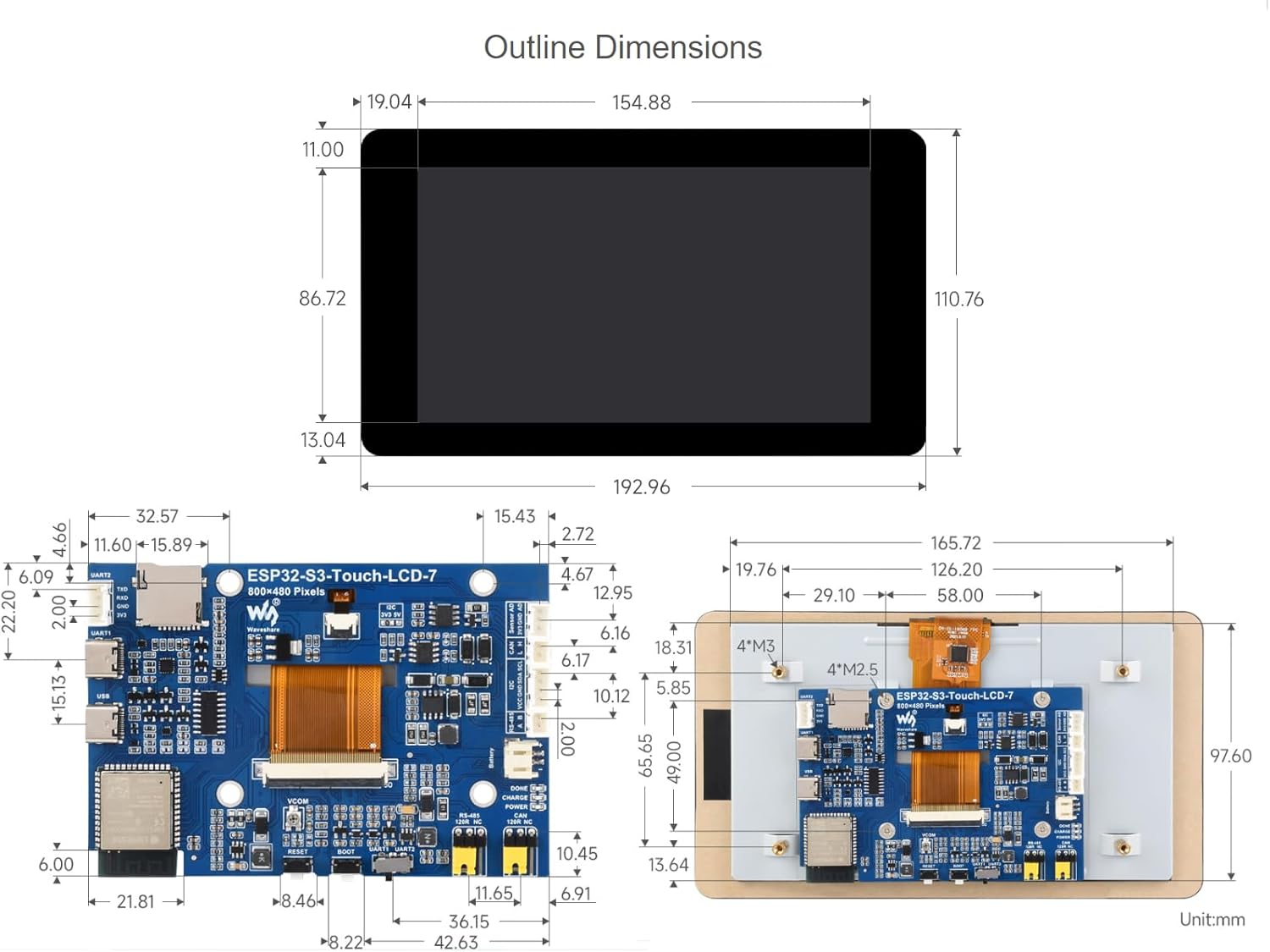
Figure 2: Outline dimensions of the ESP32-S3 7inch LCD development board.
4. Setup
4.1 Hardware Overview
The development board features various components and interfaces. Familiarize yourself with the layout for proper connection and operation.
Figure 3: Labeled diagram of the ESP32-S3 7inch LCD board components.
- ESP32-S3N8R8: SoC with WiFi and Bluetooth, up to 240MHz, 8MB PSRAM and Flash.
- Konnettur tal-batterija tal-litju waħda ta' 3.7V PH2.0.
- Konnettur tal-pannell tat-touch.
- Għażla tar-reżistur tat-terminal CAN.
- Slott tal-biljett TF.
- Għażla tar-reżistur tat-terminal RS485.
- Port USB Type-C.
- UART selection: select UART1 or UART2.
- UART1 Port.
- Buttuna BOOT: Agħfas u żomm waqt li tixgħelha biex tirrekordja l-programm.
- UART2 connector.
- buttuna RESET.
- Intestatura tas-sensur.
- I2C level selection: 3.3V / 5V.
- Intestatura tal-CAN.
- DONE: Lithium battery charging completed indicator.
- Intestatura tal-I2C.
- CHG: Lithium battery charging indicator.
- Konnettur tal-RS485.
- PWR: Power supply indicator.
4.2 Konfigurazzjoni tas-Softwer (Arduino IDE)
To program the ESP32-S3 development board, you will typically use the Arduino IDE. Follow these steps for proper setup:
- Installa l-Libreriji: Select the correct installation library path in your Arduino IDE preferences. If a 'libraries' folder does not exist, create one. Copy all necessary library files f'dan il-folder.
- Agħżel Bord: In the Arduino IDE, navigate to 'Tools' -> 'Board' and select 'ESP32S3 Dev Module'.
- Configure Flash Mode: Set the 'Flash Mode' to 'QIO 80MHz'.
- Configure Flash Size: Select 'Flash Size' as '8MB (64Mb)'.
- Configure PSRAM: Select 'PSRAM' as 'OPI PSRAM'.
- Agħżel il-Port COM: Before uploading, ensure you select the correct COM port corresponding to your connected device under 'Tools' -> 'Port'.
- Compile and Upload: Click the 'Upload' button to compile and upload your code to the board.
Video 1: This video demonstrates the software setup and upload process for an ESP32-S3 Touch-LCD board using the Arduino IDE. While it features a 4.3-inch model, the library installation, board selection, and upload steps are generally applicable to the 7-inch model.
5. It-tħaddim tal-Apparat
5.1 Interazzjoni Bażika
The 7-inch capacitive touch screen allows for intuitive interaction with your applications. The 5-point touch support enables multi-touch gestures, enhancing user experience for GUI interfaces developed with frameworks like LVGL.

Figure 4: The ESP32-S3-Touch-LCD-7 displaying a graphical user interface.
5.2 Xenarji ta' Applikazzjoni
This development board is suitable for a wide range of applications, including Human-Machine Interfaces (HMI) and GUI development using LVGL. Its multiple peripheral interfaces allow for integration with various sensors and external devices.

Figura 5: Eżamples of application scenarios for the ESP32-S3 board.
5.3 Peripheral Expansion
The board supports expansion of multiple peripherals via its CAN, RS485, and I2C interfaces, as well as UART and USB ports. This flexibility allows for complex system designs.

Figure 6: The ESP32-S3 board supporting multiple peripherals.

Figura 7: Eżample of the ESP32-S3 board in an application setup.
6. Manutenzjoni
To ensure the longevity and optimal performance of your Waveshare ESP32-S3 7inch Capacitive Touch Screen Development Board, follow these maintenance guidelines:
- Tindif: Use a soft, dry cloth to clean the screen and board. Avoid abrasive materials or harsh chemicals that could damage the components or screen coating.
- Ħażna: Store the board in a cool, dry environment away from direct sunlight, extreme temperatures, and high humidity.
- Immaniġġjar: Handle the board by its edges to avoid touching sensitive electronic components. Static electricity can damage the board, so use anti-static precautions when necessary.
- Provvista tal-Enerġija: Always use a stable and appropriate power supply as specified in the documentation to prevent damage.
7 Issolvi l-problemi
This section addresses common issues and their potential solutions:
- CAN reception failure:
- Ibda mill-ġdid il-port COM f'UCANV2.0.exe u agħfas il-buttuna reset ESP32-S3-Touch-LCD-7 diversi drabi.
- Iċċekkja DTR u RTS fl-assistent tad-debugging tal-port tas-serje.
- No screen response after uploading an Arduino demo for RGB screen displaying:
- Check whether the correct configurations are set in Arduino IDE -> Tools. Ensure 'Flash (8MB)' and 'PSRAM (8MB OPI)' are enabled.
- Fails to compile an Arduino demo for the RGB screen and shows errors:
- Verify that the ESP32-S3-Touch-LCD-7_libraries are correctly installed. Refer to the installation steps in Section 4.2.
8. Garanzija u Appoġġ
Għal informazzjoni dwar il-garanzija, appoġġ tekniku, u riżorsi addizzjonali, jekk jogħġbok żur is-sit uffiċjali ta' Waveshare webis-sit jew ikkuntattja s-servizz tal-konsumatur tagħhom. Żomm l-irċevuta tax-xiri tiegħek għal kwalunkwe talba ta’ garanzija.


