1. Introduzzjoni
This manual provides detailed instructions for the installation, operation, and maintenance of your DEATTI 8-Channel 5-in-1 Hybrid Digital Video Recorder (DVR) system, model DET-8Dc2M. This DVR is designed for home security applications, offering compatibility with various camera types including AHD, CVI, TVI, IP, and CVBS (Analog) cameras. Please read this manual thoroughly before operating the device to ensure proper setup and functionality.
2. Prodott Aktarview
The DEATTI DET-8Dc2M is an 8-channel hybrid DVR system capable of supporting multiple camera technologies. It features 1080P Lite recording and playback, HDMI and VGA outputs, and remote viewkapaċitajiet.

Figura 2.1: Quddiem view of the DEATTI 8-Channel 5-in-1 Hybrid DVR. The front panel includes control buttons for playback, menu navigation, search, PTZ control, record, and escape, along with a USB port and status indicators.
2.1. Karatteristiċi ewlenin
- 5-in-1 Hybrid Compatibility: Supports Analog, AHD, CVI, TVI, and IP cameras, allowing integration with various existing or new camera systems.
- Input b'8 Kanal: Connect up to 8 cameras for comprehensive surveillance.
- 1080P Lite Recording: Records video at 1080P Lite resolution for clear footage.
- HDMI and VGA Output: Connects to monitors or TVs for local viewing.
- Sejbien tal-Moviment: Customizable motion detection zones with email and app push notifications.
- Remote Viewing: Aċċess live view and playback from anywhere via the XMEye app on smartphones or tablets.
- Ħażna: Supports up to 8TB hard drive (not included).

Figura 2.2: Illustrates the 5-in-1 adaptive capability of the DVR, showing compatibility with AHD, CVI, IP, Analog, and TVI cameras. This allows for flexible integration with different camera technologies.
3. Gwida ta' Setup
3.1. Spakkjar u Spezzjoni Inizjali
Carefully unpack the DVR and all accessories. Verify that all components are present and undamaged. The package typically includes the DVR unit, power adapter, USB mouse, and a quick start guide.
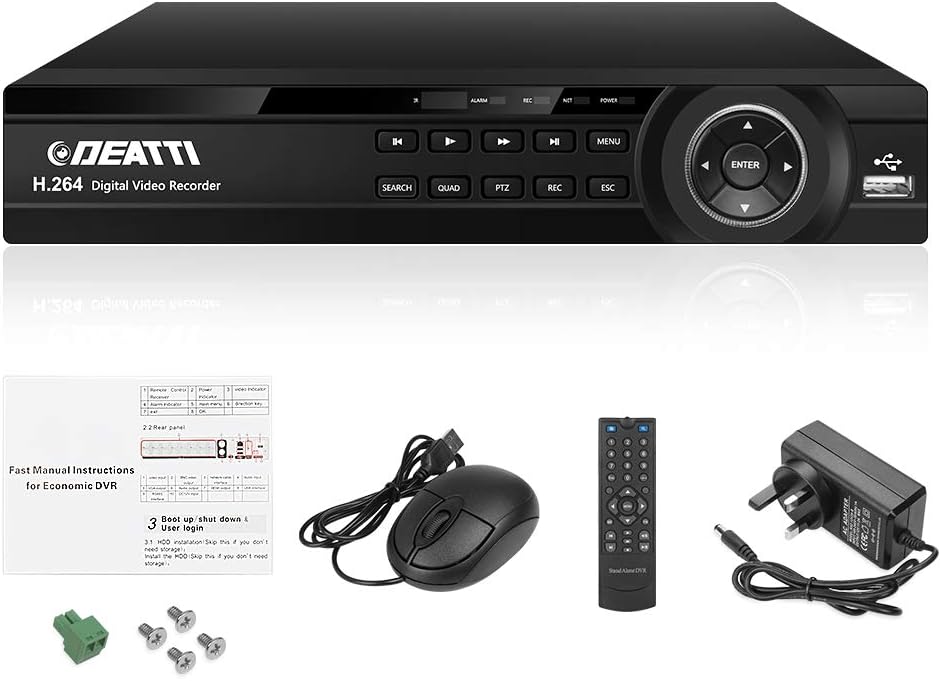
Figura 3.1: Contents of the DEATTI DVR package. This image displays the DVR unit, USB mouse, remote control, power adapter, and various connectors, indicating what is typically included with the product.
3.2. Installazzjoni tal-Hard Drive (Mhux obbligatorja)
The DVR does not include a hard drive. A 3.5-inch SATA hard drive (up to 8TB) is required for recording video footage. To install:
- Ħoll u neħħi l-għatu ta' fuq tad-DVR.
- Qabbad il-kejbils tad-dejta u tal-enerġija SATA mid-DVR mal-hard drive.
- Waħħal il-hard drive max-chassis tad-DVR billi tuża l-viti pprovduti.
- Erġa' poġġi l-għatu ta' fuq u waħħalha bil-viti.
After installation, the hard drive will need to be formatted through the DVR's system settings.
3.3. Konnessjonijiet Fiżiċi
Follow these steps to connect your DVR system:
- Qabbad il-Kameras: Connect your AHD, CVI, TVI, IP, or CVBS (Analog) cameras to the "VIDEO IN" BNC ports on the back of the DVR. Ensure BNC cables with metal locking connectors are used for optimal connection.
- Qabbad il-Monitor: Connect a monitor or TV to the DVR using either the HDMI or VGA port. The DVR supports a maximum resolution of 1920x1080 pixels (minimum 1024x768).
- Qabbad il-ġurdien: Ipplaggja l-maws USB f'wieħed mill-portijiet USB fuq id-DVR.
- Qabbad in-Netwerk (Mhux obbligatorju): Għal remoti viewing and network features, connect an Ethernet cable from the DVR's LAN port to your router.
- Qabbad Awdjo (Mhux obbligatorju): If using microphones or speakers, connect them to the "AUDIO IN" and "AUDIO OUT" ports respectively.
- Qawwa Mixgħul: Connect the power adapter to the DVR's DC 12V input and then plug it into a power outlet. Ensure the DVR is powered on separately.

Figura 3.2: Dettaljati view of the rear panel connections of the DEATTI DVR. This image labels ports for video input (BNC for CVI, CVBS, TVI, AHD cameras), audio input/output, HDMI, VGA, Ethernet (LAN), USB, RS485, and DC power input.

Figura 3.3: Step-by-step connection diagram for the DEATTI 5-in-1 DVR. It shows how to connect cameras to the DVR, the DVR to a power source and a router, and then how to access the system via smartphone app after scanning QR codes for download.
3.4. Inizjali Setup Wizard
Upon first power-on, the DVR will typically launch an initial setup wizard. Follow the on-screen prompts to:
- Oħloq password tal-login.
- Set the correct time zone and date format.
- Format the installed hard drive (if applicable).
- Configure network settings (if connected to a router).
It is recommended to allow the DVR to automatically detect and set up connected cameras initially, then adjust settings as needed.
3.5. Mobile App Setup for Remote Access
Biex view your security system remotely on a smartphone or tablet, download the XMEye app:
- Scan the QR code below or visit the provided links to download the XMEye app for your device.
- Installa l-app fuq l-ismartphone jew it-tablet tiegħek.
- Irreġistra kont u illoggja.
- Add your DVR device to the app using its unique ID (usually found in the DVR's network settings or on a sticker on the device).
- Ladarba żżidha, tista' view live video and playback recordings from anywhere.
Figura 3.4: QR codes for downloading the XMEye mobile application for both Android and iOS devices. Scanning these codes will direct users to the appropriate app store or download page.

Figura 3.5: Illustrates various devices capable of remote access to the DVR system, including smartphones, tablets, PCs, and local monitors. This highlights the flexibility of monitoring options.
4. Istruzzjonijiet Operattivi
This section covers the basic operation of your DEATTI DVR system.
4.1. Ħaj View u Navigazzjoni tal-Menù
- Kontroll tal-ġurdien: Use the USB mouse to navigate the on-screen interface. Right-click to display the mini-menu.
- Wiri tal-Kamera: Left double-click on a camera image to view it in full screen. Use the mouse scroll wheel to cycle through single camera views.
- Zoom: F'kamera waħda view, hold the left mouse button and drag a rectangle to digitally zoom. Double-click to return to normal view.
- Settings tal-Kulur: From the mini-menu, select "Color Setting" to adjust contrast and saturation for individual cameras.
4.2. Konfigurazzjoni tar-Reġistrazzjoni
To set up recording schedules:
- From the mini-menu, select "Main Menu" then "Record".
- Here you can configure all cameras to record continuously or set individual cameras to record at scheduled times.
- For motion-triggered recording, uncheck the "Regular" box and ensure motion detection is enabled (see Section 4.3).
4.3. Sejbien tal-Mozzjoni u Twissijiet
The DVR supports customizable motion detection with alerts:
- From the mini-menu, select "Main Menu" then "Alarm".
- Select the desired channel number. Check the "Enable" box to activate motion detection for that channel.
- Customize motion detection areas and sensitivity (e.g., "Middle" sensitivity is often a good starting point).
- Configure alert actions such as email notifications and app push notifications to your phone.
- Set "Pre-record" and "Post-record" options (e.g., 30 seconds pre-record, 120 seconds post-record) to capture events before and after motion is detected.
4.4. Daqq
Biex terġa 'view irreġistrat footage:
- From the mini-menu, select "Main Menu" then "Record" then "Playback".
- Select the desired channel and date/time range.
- Use the playback controls (pause, stop, fast/slow forward/backward, frame-by-frame) to navigate through the footage.
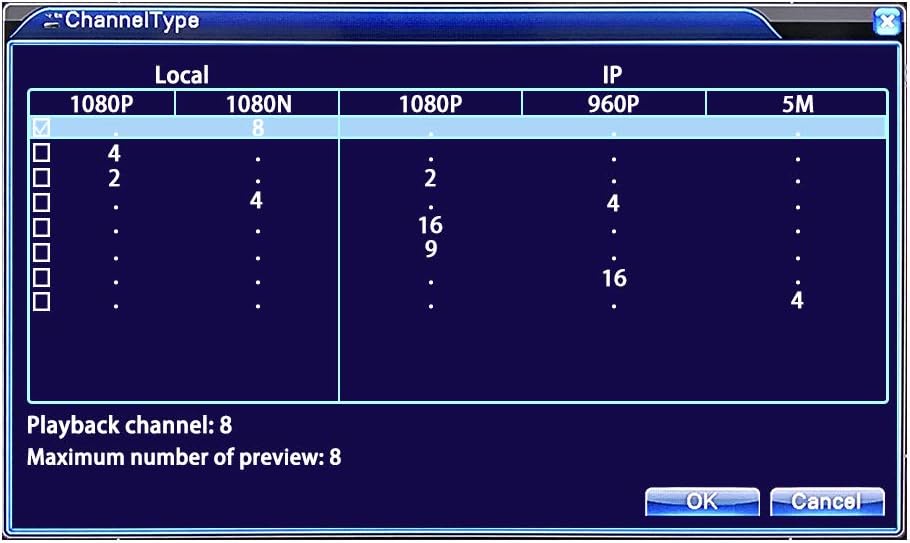
Figura 4.1: Screenshot of the DVR's "ChannelType" configuration screen. This interface allows users to select and configure local (AHD/CVI/TVI/CVBS) and IP camera channels, specifying resolutions like 1080P, 1080N, 960P, and 5M, and indicating the maximum number of preview and playback channels.
4.5. Backup Recorded Material
To back up footage to an external storage device (e.g., USB flash drive):
- Insert the USB storage device into a USB port on the DVR.
- From the mini-menu, select "Main Menu" then "Record" then "Backup".
- Click "Detect" to ensure the storage device is recognized.
- Click "Backup Clear" to remove any existing listed files from previous backups.
- Select the desired channel(s) and right-click on the date/time numbers to set the specific period for backup. Click "Add" to include files fil-lista.
- Choose the desired backup format (MP4, H264/5, or AVI) and click "Start". Note that MP4 and H264/5 formats may require specific players.
5. Manutenzjoni
5.1. Ġestjoni tal-Hard Drive
Regularly check the status of your hard drive through the DVR's system settings to ensure it is functioning correctly and has sufficient space. If the hard drive becomes full, the DVR will typically overwrite the oldest footage. You can also configure the DVR to stop recording when the hard drive is full.
5.2. Time and Date Battery
The DVR uses a CR2032 button battery for maintaining the time and date stamp. This battery is pre-installed but will need to be replaced occasionally to ensure accurate timekeeping, especially after power outages.
5.3. Kura Ġenerali
- Żomm id-DVR f'żona ventilata sew biex tevita li jisħon iżżejjed.
- Avoid placing the DVR near strong electromagnetic fields.
- Ensure camera cables are laid neatly and not tangled or crossing over each other. Keep the mouse cable and DVR power cable separate from camera cables to minimize interference.
- Naddaf il-barra tad-DVR b'ċarruta ratba u niexfa. Tużax prodotti tat-tindif likwidi.
6 Issolvi l-problemi
6.1. No Display on Monitor/TV
- Iċċekkja Kejbils: Ensure HDMI or VGA cables are securely connected to both the DVR and the monitor/TV.
- Kompatibilità tal-monitor: This DVR may not support older TVs/monitors with very low resolution. Ensure your display supports at least 1024x768 pixels. Do not use a laptop or iMac as a monitor.
- Qawwa: Verify the DVR is powered on and its power adapter is functioning correctly.
6.2. No Camera Image
- Qawwa tal-Kamera: Ensure cameras are powered on and receiving adequate power.
- Konnessjoni tal-Cable: Check BNC video cables for secure connections at both the camera and DVR ends.
- Kompatibbiltà tal-kamera: Verify that the camera type (AHD, CVI, TVI, IP, CVBS) is compatible with the DVR and correctly configured in the DVR's channel settings.
6.3. Remote Viewing Issues
- Konnessjoni tan-Netwerk: Ensure the DVR is connected to your router via an Ethernet cable and has internet access.
- Konfigurazzjoni tal-App: Double-check that the DVR device has been correctly added to the XMEye app using its unique ID.
- Settings tal-router: If issues persist, check your router's firewall or port forwarding settings, though P2P functionality often bypasses manual port forwarding.
6.4. Recording Problems
- Hard Drive: Verify that a hard drive is installed, formatted, and has sufficient free space. Check its status in the DVR's system settings.
- Skeda ta 'Reġistrazzjoni: Ensure recording schedules are correctly configured (continuous, motion-triggered, or scheduled times).
- Sejbien tal-Moviment: If using motion detection, confirm it is enabled and configured for the relevant channels.
7. Speċifikazzjonijiet
| Karatteristika | Speċifikazzjoni |
|---|---|
| Numru tal-Mudell | DET-8Dc2M |
| Input tal-Vidjo | 8 Channels (AHD, CVI, TVI, IP, CVBS/Analog) |
| Output tal-vidjo | HDMI, VGA (Max 1920x1080) |
| Input Awdjo | BNC |
| Riżoluzzjoni ta' Reġistrazzjoni | 1080P Lite |
| Appoġġ għal Hard Disk | 1 x SATA HDD, up to 8TB (HDD not included) |
| Konnettività | Ethernet (LAN), USB |
| Applikazzjoni ta' Aċċess Remot | XMEye |
| Provvista tal-Enerġija | DC 12V |
| Dimensjonijiet | 32.79 x 31 x 7.9 ċm |
| Piż | 1.31 kg |
| Batterija Interna | 1 x CR2032 Lithium Metal (inkluża) |
8. Garanzija u Appoġġ
DEATTI provides a full 2-year warranty for this product and lifetime technical support. For any inquiries or assistance, please contact DEATTI customer support directly. The product holds CE & FCC Certificates and complies with UL standards for power supplies.


