1. Introduzzjoni
This user manual provides detailed instructions for the installation, operation, and troubleshooting of the SIIG HDMI 2.0 Audio Extractor (Model: CE-H24F11-S1). This device is designed to split an incoming HDMI audio signal into stereo analog audio and Toslink optical outputs, enabling connection to various audio systems that may lack HDMI input.
The extractor supports high-resolution video up to 4K/60Hz with HDR and is compliant with HDCP 2.2. It also features ARC (Audio Return Channel) support via Toslink and CEC bypass, ensuring compatibility with modern home theater setups. Please read this manual thoroughly before use to ensure proper setup and optimal performance.
2. Karatteristiċi tal-prodott
- HDMI 2.0a and HDCP 2.2 compliant.
- Supports HDCP 2.2, HDR, and CEC bypass.
- Video resolutions up to 4Kx2K@60Hz YUV 4:4:4 8-bit and 4K HDR YUV 4:2:0 10-bit.
- Supports 480p, 720p, 1080i, 1080p resolutions.
- Video bandwidth: 18Gbps (600MHz per channel).
- Audio extraction via 3.5mm stereo jack and Toslink optical output.
- ARC audio extraction via Toslink (S/PDIF).
- Supports audio embedded via stereo and S/PDIF (Toslink).
- Formati awdjo appoġġjati:
- HDMI: PCM 2/5.1/7.1, Dolby 5.1/7.1, DTS 5.1/7.1
- Toslink (S/PDIF): PCM 2, Dolby 5.1, DTS 5.1
- 3.5mm Stereo: PCM 2
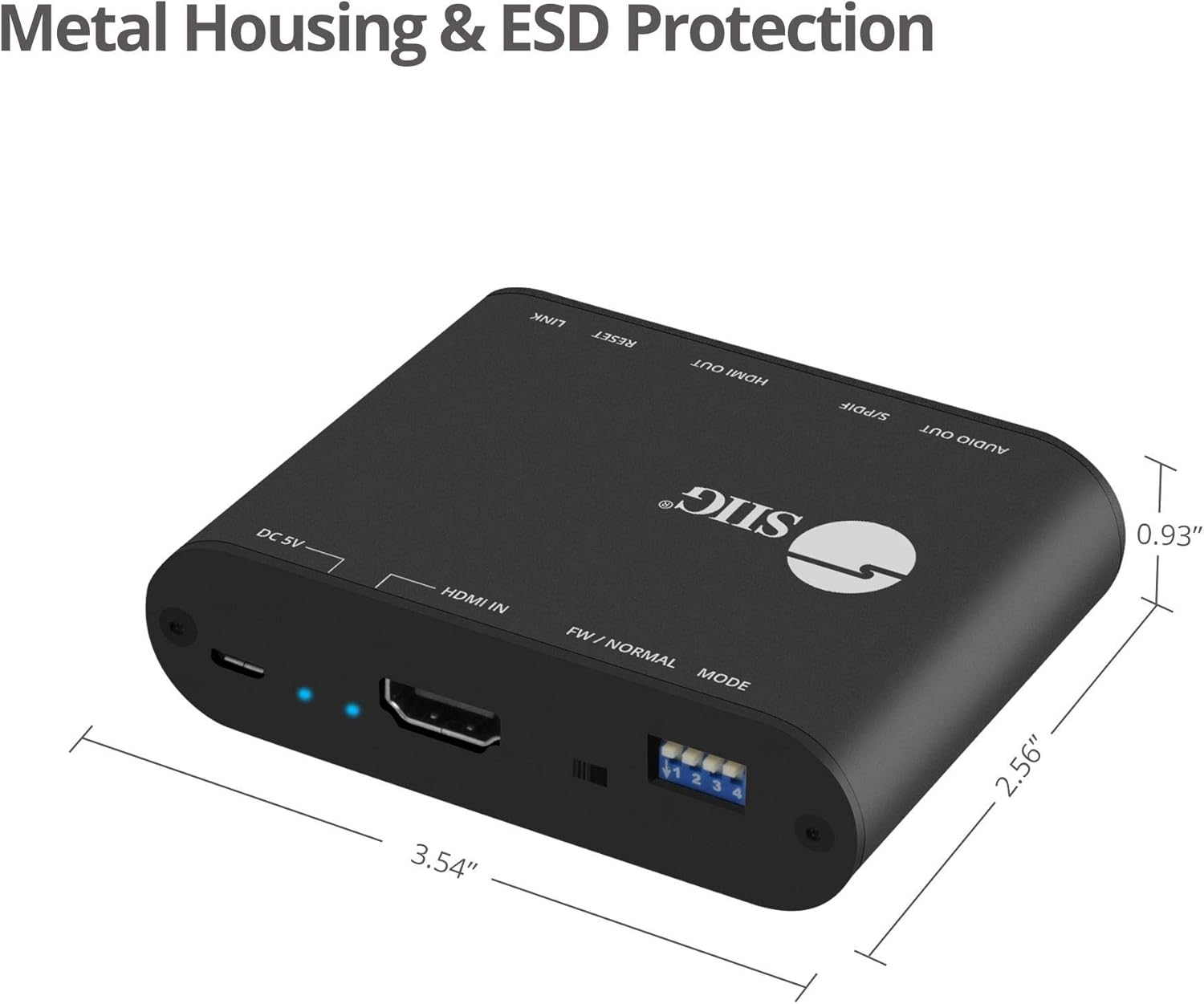
- Sturdy metal enclosure for durability and EMI/RFI noise interference minimization.
- ESD protection: ±15kV Air & ±8kV Contact.
- Country of origin: Taiwan.
- Regulatory approvals: FCC, CE, RoHS.

3. Kontenut tal-Pakkett
Please verify that all items are present and in good condition. If any items are missing or damaged, contact your vendor for assistance.
- 1x HDMI 2.0 Audio Extractor/Embedder (CE-H24F11-S1)
- 1x USB Type-A to Micro B Cable (for power)
- 1x Installation Guide (this document)
4. Prodott Aktarview and Port Descriptions


Panel ta' quddiem:
- 3.5mm Stereo Output: Connect to analog audio devices (e.g., headphones, stereo speakers).
- S/PDIF (Toslink) Output: Connect to digital optical audio receivers or soundbars.
- Ħruġ HDMI: Connect to an HDMI display (e.g., TV, monitor, projector).
- Output Signal LED Indicator: Illuminates when an HDMI output signal is detected.
- Buttuna Irrisettja: Użat biex reset l-apparat.
- Slide Switch (FW/NORMAL Mode):
- Left (FW): Firmware update mode.
- Right (NORMAL): Normal operating mode. Ensure this is set to NORMAL for regular use.
Bord ta 'wara:
- Micro-USB Port (DC 5V): Connect the provided USB power cable for device power. Also used for firmware updates.
- Indikatur LED tal-Enerġija: Jixgħel meta l-apparat ikun mixgħul.
- Input Signal LED Indicator: Illuminates when an HDMI input signal is detected.
- Input HDMI: Connect to an HDMI source device (e.g., Blu-ray player, game console, streaming device).
- 4-pin DIP Switch: Used to configure EDID settings and enable/disable ARC and audio extraction functions.
5. Istruzzjonijiet ta' Setup
Follow these steps to set up your SIIG HDMI 2.0 Audio Extractor:
- Apparat mitfi: Ensure all source devices, displays, and audio systems are powered off before making any connections.
- Qabbad l-Input HDMI: Connect an HDMI cable from your source device (e.g., Blu-ray player, game console) to the HDMI-IN port on the audio extractor.
- Connect HDMI Output: Qabbad kejbil HDMI mill- HDMI OUT port on the audio extractor to your display device (e.g., TV, monitor, projector).
- Connect Audio Output (Digital): For digital audio, connect a Toslink (optical) cable from the S/PDIF (Toslink) Output port on the extractor to your audio receiver, soundbar, or ampaktar ħaj.
- Connect Audio Output (Analog): For analog stereo audio, connect a 3.5mm audio cable from the 3.5mm Output Stereo port on the extractor to your headphones or stereo speakers.
- Qabbad l-Enerġija: Connect the provided USB Type-A to Micro B cable to the Port mikro-USB (DC 5V) on the extractor and the other end to a USB power source (e.g., USB wall adapter, TV USB port). The Power LED Indicator will illuminate.
- Verify Slide Switch: Ensure the slide switch on the front panel is set to the NORMALI position (right).
- Apparat ta' Qawwa: Power on your display, audio system, and source device in that order.

6. Istruzzjonijiet Operattivi
6.1 EDID and Function Configuration (DIP Switch)
The 4-pin DIP switch on the back panel allows you to configure the EDID (Extended Display Identification Data) settings and control the ARC and audio extraction functions. Adjust these settings based on your connected devices and desired audio output.

| Pożizzjoni tal-Iswiċċ DIP | Deskrizzjoni |
|---|---|
| PIN1: OFF, PIN2: OFF | Bypass EDID |
| PIN1: OFF, PIN2: ON | Ultra HD (4K2K@60Hz) – 8/10/12bit, 3D, HDR video & 5.1ch audio |
| PIN1: ON, PIN2: OFF | Ultra HD (4K2K@60Hz) – 8/10/12bit, 3D, HDR video & 2ch audio |
| PIN1: ON, PIN2: ON | Learning EDID from Output |
| PIN3: OFF | Disable ARC Function |
| PIN3: ON | Enable ARC Function |
| PIN4: OFF | Disable Audio Extractor Function |
| PIN4: ON | Enable Audio Extractor Function (via Toslink & 3.5mm) |
Nota: After changing DIP switch settings, it is recommended to power cycle the audio extractor and all connected devices to ensure the new settings are applied correctly.
6.2 ARC (Audio Return Channel) Function
When ARC is enabled (PIN3 ON) and your display supports ARC, audio from your TV's internal tuner or smart apps can be sent back to the audio extractor via the HDMI cable and then output through the Toslink (S/PDIF) port to your audio system.

6.3 CEC Bypass
The device supports CEC (Consumer Electronics Control) bypass, allowing CEC commands to pass through the extractor to control connected HDMI devices. This means you can use a single remote to control multiple CEC-enabled devices in your setup.
7 Issolvi l-problemi
If you encounter issues with the SIIG HDMI 2.0 Audio Extractor, please refer to the following common troubleshooting steps:
- Ebda Output tal-Vidjo:
- Kun żgur li l-kejbils HDMI kollha huma konnessi sew.
- Verify the input source is selected correctly on your display.
- Check the power connection to the extractor; the Power LED should be illuminated.
- Ipprova kejbil HDMI ieħor.
- Adjust DIP switch settings for EDID (PIN1 & PIN2) to match your display's capabilities or try "EDID bypass".
- Power cycle all connected devices (source, extractor, display).
- No Audio Output (Toslink/3.5mm):
- Ensure audio cables (Toslink or 3.5mm) are securely connected to the correct output ports on the extractor and input ports on your audio system.
- Verify the audio input is selected correctly on your audio receiver/soundbar.
- Check DIP switch PIN4 is set to ON to enable audio extraction.
- If using ARC, ensure DIP switch PIN3 is set to ON and your TV's ARC function is enabled.
- Confirm the audio format from your source is supported by your audio system and the extractor (refer to "Product Features" for supported formats). Some audio systems may not support certain multi-channel formats.
- Try setting DIP switch PIN1: ON, PIN2: OFF for 2ch audio output if your audio system only supports stereo.
- Power cycle all connected devices.
- Intermittent Video/Audio:
- Iċċekkja għal konnessjonijiet tal-kejbil maħlula.
- Kun żgur li l-provvista tal-enerġija hija stabbli.
- Reduce cable lengths if possible, especially for HDMI.
- Verify that the slide switch is in the NORMALI pożizzjoni.
- Test with different HDMI cables.
- HDR/4K Issues:
- Ensure all connected HDMI cables are rated for HDMI 2.0 or higher and support 18Gbps bandwidth.
- Verify your source and display devices both support 4K/60Hz and HDR.
- Adjust EDID settings (PIN1 & PIN2) to ensure the correct video mode is selected.
8. Speċifikazzjonijiet
| Karatteristika | Dettall |
|---|---|
| Numru tal-Mudell | CE-H24F11-S1 |
| Konformità HDMI | HDMI 2.0a |
| Konformità HDCP | HDCP 2.2 |
| Vidjo tal-Bandwidth | 18Gbps (600MHz per channel) |
| Riżoluzzjonijiet Appoġġjati | Up to 4Kx2K@60Hz (YUV 4:4:4 8-bit), 4K HDR (YUV 4:2:0 10-bit), 1080p, 1080i, 720p, 480p |
| Appoġġ HDR | Yes (4K@60Hz YUV 4:2:0 10-bit) |
| Riżultati Awdjo | 1x Toslink (S/PDIF), 1x 3.5mm Stereo |
| Appoġġ ARC | Yes (via Toslink) |
| Appoġġ CEC | Bypass |
| Protezzjoni ESD | ±15kV Air & ±8kV Contact |
| Materjal | Egħluq tal-metall |
| Dimensjonijiet tal-Prodott (T x W) | 4.56" x 0.78" (11.58 ċm x 1.98 ċm) |
| Piż tal-oġġett | 6.4 uqija (181.4 gramma) |
| Provvista tal-Enerġija | DC 5V (via Micro-USB) |
| Temperatura operattiva | Sa 104°F (40°C) |
| Ċertifikazzjonijiet | FCC, CE, RoHS, TAA compliant |
| Pajjiż ta' Oriġini | Tajwan |
9. Manutenzjoni
The SIIG HDMI 2.0 Audio Extractor is designed for reliable operation with minimal maintenance.
- Tindif: Use a soft, dry cloth to clean the device. Avoid using liquid or aerosol cleaners, as they may damage the unit.
- Ventilazzjoni: Kun żgur li l-apparat jitqiegħed f'żona ventilata sew biex tevita li jisħon iżżejjed. Timblokkax xi fetħiet tal-ventilazzjoni.
- Ħażna: Meta ma tkunx qed tużah għal perjodi twal, aħżen l-apparat f'post frisk u niexef 'il bogħod mix-xemx diretta u minn temperaturi estremi.
- Aġġornamenti tal-Firmware: Periodically check the SIIG website for any available firmware updates for your model. Follow the instructions provided with the firmware update carefully.
10. Informazzjoni dwar is-Sigurtà
Please observe the following safety guidelines to prevent damage to the device and ensure user safety:
- Tesponix l-apparat għall-ilma jew għal umdità eċċessiva.
- Do not attempt to open or modify the device. There are no user-serviceable parts inside.
- Use only the provided power cable or a certified 5V USB power adapter.
- Żomm l-apparat 'il bogħod minn sorsi ta' sħana, dawl tax-xemx dirett, u materjali fjammabbli.
- Ensure proper grounding for all connected electrical equipment.
11. Garanzija u Appoġġ Tekniku
11.1 Informazzjoni dwar Garanzija
The SIIG HDMI 2.0 Audio Extractor (CE-H24F11-S1) comes with a garanzija ta 'sena. This warranty covers defects in materials and workmanship under normal use. For specific terms and conditions, please refer to the warranty documentation provided with your purchase or visit the official SIIG websit.
11.2 Appoġġ Tekniku
For technical assistance, product inquiries, or troubleshooting beyond the scope of this manual, please contact SIIG customer support.
- Websit: Visit the official SIIG websit għal riżorsi ta' appoġġ, FAQs, u informazzjoni ta' kuntatt.
- Kuntatt: Refer to your product packaging or the SIIG website for the most current contact details for technical support.


