
1. Introduzzjoni
The SKYSHL SS103PVC12 Optical Fiber Power Meter (OPM) is a compact and user-friendly instrument designed for comprehensive testing of fiber optic networks. It facilitates both absolute optical power measurement and relative optical loss measurement. This device is characterized by its robust design, wide power measurement range, high precision, and user self-calibration capabilities, making it a cost-effective solution for fiber optic professionals.
This manual provides detailed instructions for the safe and effective use of your SKYSHL SS103PVC12. Please read it thoroughly before operation and retain it for future reference.
2. Informazzjoni dwar is-Sigurtà
Osserva l-prekawzjonijiet ta' sigurtà li ġejjin biex tevita korrimenti u ħsara lill-apparat:
- Sigurtà tal-Laser: The Visual Fault Locator (VFL) emits a visible red laser. Tħaresx direttament fir-raġġ tal-lejżer jew view dan b'istrumenti ottiċi. Direct exposure can cause severe eye injury.
- Sigurtà tal-batterija: Use only the specified battery type (3.7V 700mAh lithium battery). Do not disassemble, puncture, or expose the battery to extreme temperatures or fire. Dispose of batteries according to local regulations.
- Kundizzjonijiet Ambjentali: Operate the device within specified temperature and humidity ranges. Avoid exposure to water, dust, and corrosive substances.
- Tindif: Use a soft, dry cloth for cleaning the device. For optical connectors, use specialized fiber optic cleaning tools.
- Manutenzjoni: Tippruvax tiftaħ jew issewwi l-apparat int stess. Irreferi għal kull manutenzjoni f'idejn persunal kwalifikat.
3. Kontenut tal-Pakkett
Ivverifika li l-oġġetti kollha huma preżenti fil-pakkett:
- 1 x SKYSHL SS103PVC12 Optical Fiber Power Meter
- 1 x USB-A to Micro USB Charging Cable
- 1 x FC-LC Adapter
- 1 x Manwal tal-Utent (dan id-dokument)

4. Prodott Aktarview
The SKYSHL SS103PVC12 is an all-in-one tool for fiber optic network testing. It combines an Optical Power Meter (OPM), a Visual Fault Locator (VFL), an RJ45 cable tester, and an LED flashlight.
4.1 Karatteristiċi ewlenin
- Multi-Wavelength Calibration: Supports 10 calibrated wavelengths: 850nm, 980nm, 1270nm, 1300nm, 1310nm, 1490nm, 1550nm, 1577nm, 1625nm, and 1650nm, suitable for both single-mode and multi-mode fiber testing.
- Firxa Wiesgħa ta' Kejl: Measures optical power from -50dBm to +26dBm.
- Integrated VFL: 650nm red laser with a 30km range for identifying fiber breaks and continuity.
- RJ45 Cable Tester: For quick localization and testing of 8P/6P/4P network cables.
- Universal Connector Compatibility: Features a 2.5mm universal connector (compatible with FC/SC/ST) and includes an FC-LC adapter for LC connectors.
- Ħajja twila tal-batterija: Powered by a 3.7V 700mAh lithium battery, providing over 120 hours of typical operation.
- Disinn kompatt u Durabbli: Ergonomic, portable, and built with high-strength plastic casing for resilience.
- Display LCD ta '2 pulzieri: Clear and easy-to-read interface.
4.2 Layout tal-Apparat


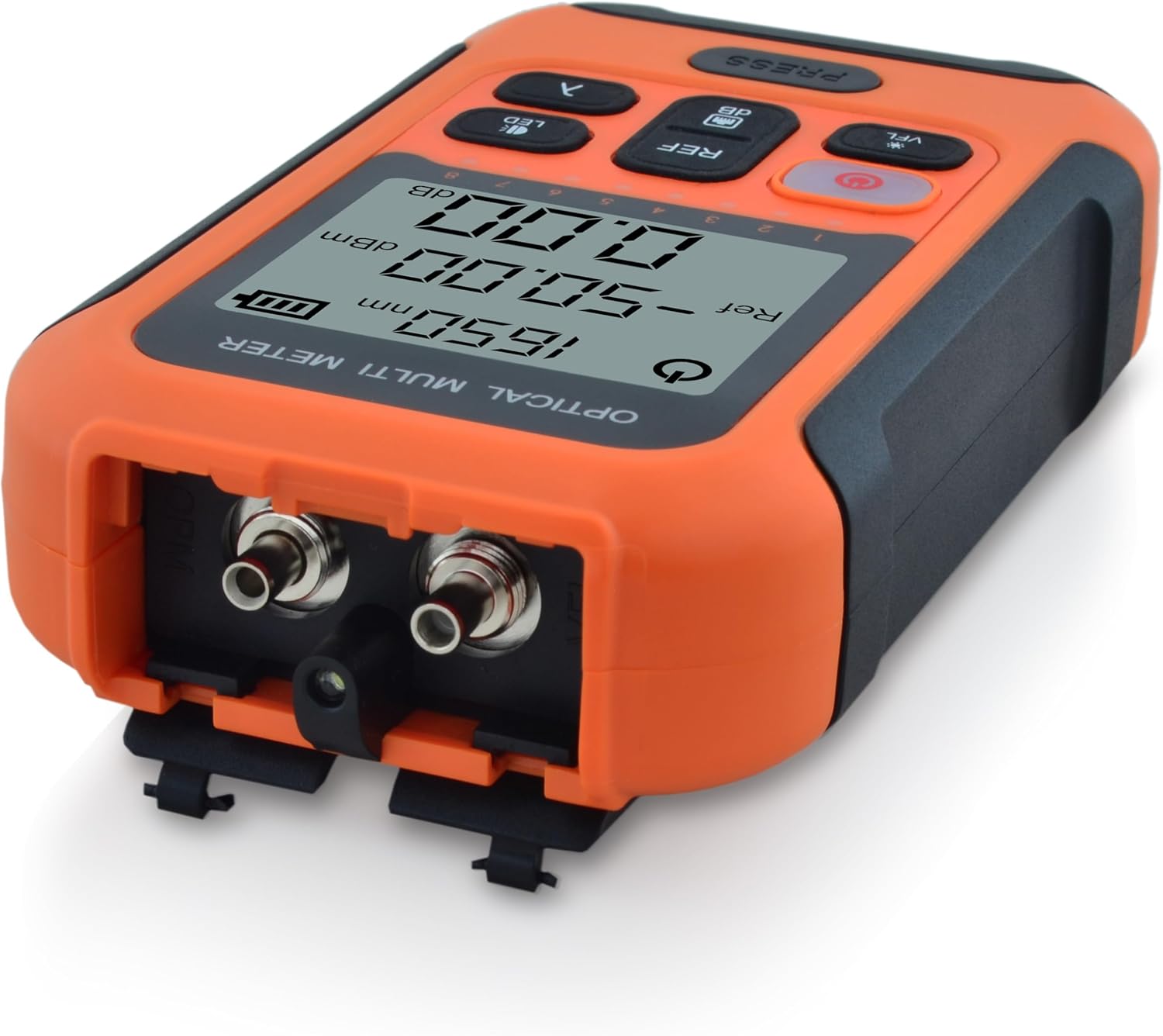
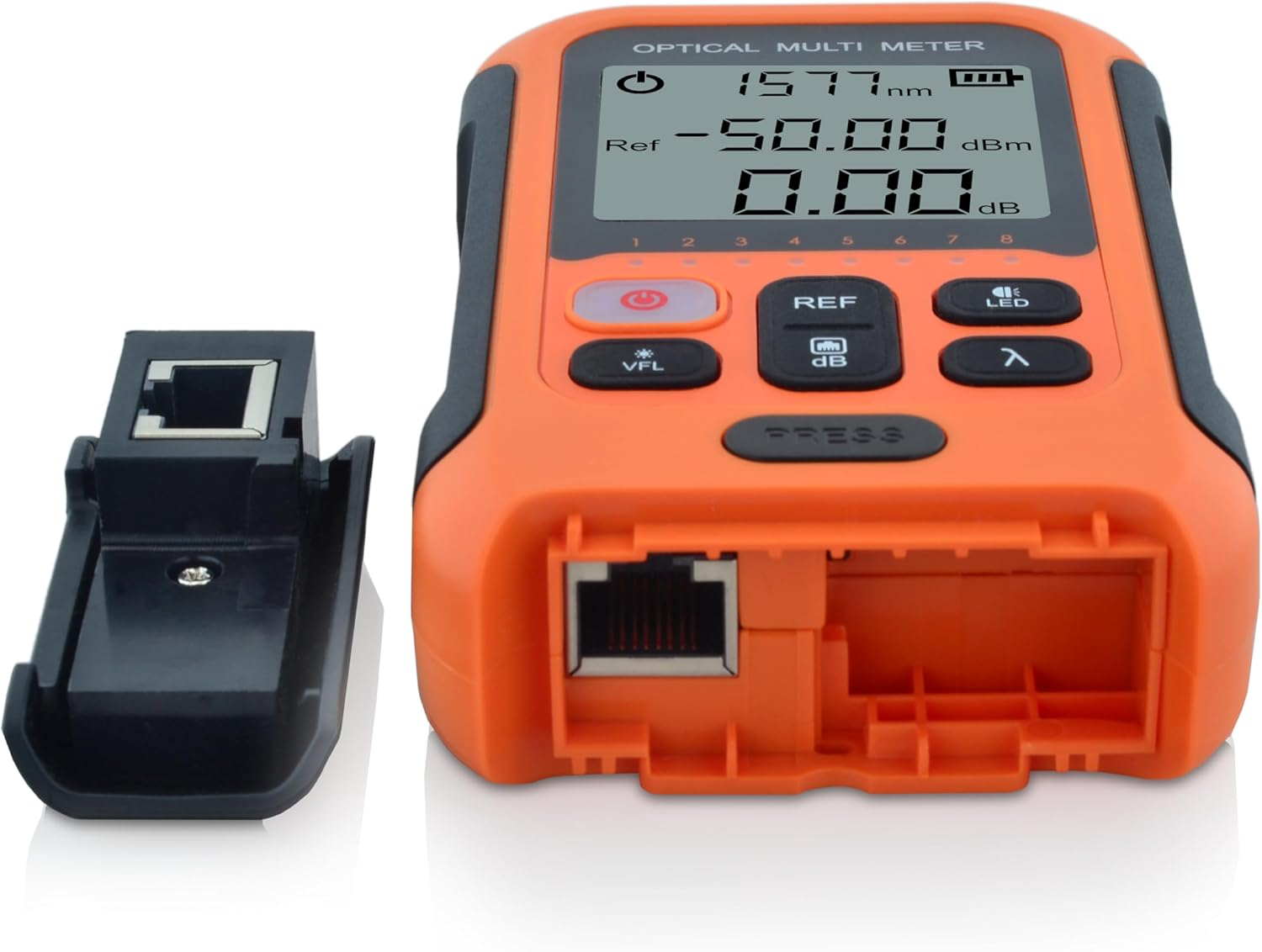
5. Setup
5.1 Iċċarġjar tal-batterija
The device is powered by a built-in 3.7V 700mAh lithium battery. Before first use, or when the battery indicator on the display shows low charge, connect the device to a USB power source using the provided Micro USB cable. The power button will illuminate red during charging.
5.2 Connecting Fiber Optic Cables
- Ensure the fiber optic connector is clean. Use a fiber optic cleaning tool if necessary.
- For FC, SC, or ST connectors, directly insert them into the 2.5mm universal port on the top of the device.
- For LC connectors, attach the provided FC-LC adapter to the universal port, then insert the LC connector into the adapter.
- Ensure a secure connection to prevent inaccurate readings.
5.3 Connecting RJ45 Cables
- Detach the small RJ45 module from the side of the main unit.
- Connect one end of the RJ45 cable to the port on the main unit.
- Connect the other end of the RJ45 cable to the detached module.
- Proceed to the operating instructions for RJ45 cable testing.
6. Istruzzjonijiet Operattivi
6.1 Power On/Off
- Biex tixgħel, agħfas u żomm il-buttuna Buttuna tal-Qawwa (red button with power symbol) for approximately 2 seconds.
- Biex tintefa, agħfas u żomm il-buttuna Buttuna tal-Qawwa again for approximately 2 seconds.
- The device features an automatic power-off function after 10 minutes of inactivity to conserve battery.
6.2 Optical Power Measurement (OPM)
- Agħżel it-Tul tal-Mewġa: Agħfas il- λ (Wavelength) Button to cycle through the available calibrated wavelengths (850nm, 980nm, 1270nm, 1300nm, 1310nm, 1490nm, 1550nm, 1577nm, 1625nm, 1650nm). Select the wavelength corresponding to your fiber optic system.
- Qabbad il-Fibra: Connect the fiber optic cable to the appropriate port as described in Section 5.2.
- Read Absolute Power: The display will show the measured optical power in dBm.
- Set Reference (Relative Measurement):
- With a known good signal connected, press the REF/dB Button to set the current power reading as the reference value (0.00dB).
- When measuring other points in the fiber link, the display will show the relative loss or gain in dB compared to the set reference.
- Agħfas il- REF/dB Button again to toggle between absolute (dBm) and relative (dB) measurements.
6.3 Lokatur Viżwali ta' Ħsarat (VFL)
- Activate VFL: Agħfas il- VFL Button. The 650nm red laser will emit from the VFL port (located near the fiber optic input ports).
- Identify Faults: Connect the fiber to be tested to the VFL port. Observe the fiber for any visible red light leakage, which indicates breaks, sharp bends, or faulty connectors.
- Deactivate VFL: Agħfas il- VFL Button again to turn off the laser.
- Attenzjoni: Always follow laser safety guidelines (Section 2).
6.4 RJ45 Cable Tester
- Ensure the RJ45 cable is connected to both the main unit and the detached module as described in Section 5.3.
- The device will automatically begin testing the cable continuity. The display will show the status of each wire pair (1-8 for 8P, 1-6 for 6P, 1-4 for 4P).
- A successful test will show all corresponding numbers lighting up sequentially or indicating continuity. Any missing or incorrect sequence indicates a fault (e.g., open, short, cross).
6.5 Linterna LED
- Agħfas il- Buttuna LED to turn the integrated LED flashlight on or off. This is useful for working in dimly lit environments.
7. Manutenzjoni
- Cleaning Optical Connectors: Regularly clean the fiber optic input ports and any adapters using specialized fiber optic cleaning swabs or pens. Dust and debris are the primary causes of inaccurate measurements.
- Tindif tal-Apparat: Wipe the exterior of the device with a soft, dry, lint-free cloth. Do not use abrasive cleaners or solvents.
- Kura tal-batterija: For optimal battery life, avoid fully discharging the battery frequently. If storing the device for an extended period, charge it to approximately 50% and recharge every few months.
- Ħażna: Store the device in a cool, dry place, away from direct sunlight and extreme temperatures. Use the protective caps for all ports when not in use.
8 Issolvi l-problemi
| Problema | Kawża Possibbli | Soluzzjoni |
|---|---|---|
| L-apparat ma jixgħelx. | Batterija baxxa jew eżawrita. | Iċċarġja l-apparat billi tuża l-kejbil USB ipprovdut. |
| Inaccurate or unstable OPM readings. | Dirty fiber optic connectors or incorrect wavelength setting. | Clean all fiber optic connectors. Ensure the correct wavelength is selected on the device. |
| Id-dawl aħmar tal-VFL huwa baxx jew mhux viżibbli. | Dirty VFL port or fiber connection. | Clean the VFL port and the fiber end-face. |
| RJ45 cable test fails or shows incorrect pinout. | Faulty RJ45 cable, poor connection, or damaged port. | Ensure the cable is properly seated. Test with a known good cable. Inspect cable for damage. |
| L-apparat jiffriża jew ma jibqax jirrispondi. | Problema temporanju tas-softwer. | Press and hold the Power Button for 10 seconds to force a restart. |
If the problem persists after attempting these solutions, please contact SKYSHL customer support for assistance.
9. Speċifikazzjonijiet
| Parametru | Valur |
|---|---|
| Tip ta' Ditekter | InGaAs |
| Calibrated Wavelengths | 850nm, 980nm, 1270nm, 1300nm, 1310nm, 1490nm, 1550nm, 1577nm, 1625nm, 1650nm |
| Medda ta' Kejl | -50~+26dBm (CW/1Hz/2Hz) |
| VFL Wavelength/Range | 650nm / 30km |
| Power Measurement Uncertainty | ± 0.3dB |
| Konnetturi | Universal 2.5mm (FC/SC/ST compatible), FC-LC adapter, RJ45 |
| Auto Power Mitfi | minuti 10 |
| Provvista tal-Enerġija | 3.7V 700mAh Batterija tal-litju |
| Wiri | LCD ta '2 pulzieri |
| Ħin Operattiv | >120 hours (typical) |
| Dimensjonijiet (L x W x H) | 120 x 70 x 27 mm (4.72 x 2.76 x 1.06 pulzieri) |
| Piż | 0.13 KG (0.29 lbs) |
| Manifattur | SKYSHL |
| Numru tal-Mudell | SS103PVC12 |
| Kulur | Oranġjo |
| Pajjiż ta' Oriġini | Iċ-Ċina |
10. Garanzija u Appoġġ
SKYSHL provides the following warranty for the SS103PVC12 Optical Fiber Power Meter:
- 3 Years Free Replacement
- 5 Years Free Maintenance
- Garanzija tul il-ħajja
For technical support, warranty claims, or any inquiries regarding your device, please contact SKYSHL customer service through the retailer where you purchased the product or visit the official SKYSHL websit għal informazzjoni ta' kuntatt.