
1. Introduzzjoni
Thank you for choosing the XTUGA MRV122FX 12-Channel Audio Mixer. This professional mixing console is designed for high-quality audio performance in various settings, including live gigs, studio recording, and DJ events. It features an ultra-low noise design, advanced microphone preamplifiers, a built-in digital effects processor, Bluetooth connectivity, and USB playback/recording capabilities. This manual provides detailed instructions to help you set up, operate, and maintain your mixer for optimal performance.

Stampa 1.1: Quddiem view of the XTUGA MRV122FX 12-Channel Audio Mixer, showcasing all controls and input/output sections.
2. Karatteristiċi ewlenin
- Ultra-Low Noise Design: Engineered for the highest possible headroom and minimal noise interference.
- Studio-Grade XDR2 Mic Preamps: Equipped with 6-16 Extended Dynamic Range mic preamplifiers, offering a 60dB gain range, 130dB dynamic range, and +22dBu line input handling.
- Qawwa fantasma: +48V phantom power available for condenser microphones.
- Kanal EQ: 4-band active EQ on mono channels (High, Mid-high, Mid-low, Low) and 2-band EQ on stereo channels. Includes an 18dB/octave, 75Hz Lo-Cut filter on mic channels.
- Built-in Digital Effects Processor: Features 16 high-quality 24-bit DSP effects with Tap Tempo functionality.
- Multi-format Play Support: Integrated Bluetooth for wireless audio streaming from mobile devices, and a digital display MP3 player with U-DISK input and recording (REC) function.
- Two-Way USB Function: Allows music playback via USB and connection to a computer for recording.
- Kostruzzjoni imħatteb: Ultra-fashion all-metal chassis design for durability and high-density dust resistance.
- Provvista ta 'Enerġija Universali: Multi-voltage power supply (100-240V) for worldwide use.
- Dual 7-Band Stereo Graphic Equalizer: For precise overall mix adjustment.
3. Setup
3.1 Spakkjar u Tqegħid
Carefully remove the mixer from its packaging. Inspect the unit for any signs of damage. Place the mixer on a stable, flat surface, ensuring adequate ventilation around the unit.
3.2 Konnessjoni tal-Enerġija
Connect the provided power cable to the mixer's power input and then to a suitable AC power outlet (100-240V). Ensure the power switch is in the OFF position before connecting. The mixer is designed with a multi-voltage power supply for global compatibility.

Image 3.1: Rear panel of the mixer showing the 100-240V power input and fuse holder.
3.3 Konnessjoni tal-Inputs
The MRV122FX features 12 input channels, including 10 mono microphone/line inputs and 2 stereo line inputs (channels 9/10 and 11/12). Channels 1-8 are mono inputs with XLR and 1/4" TRS/TS jacks.
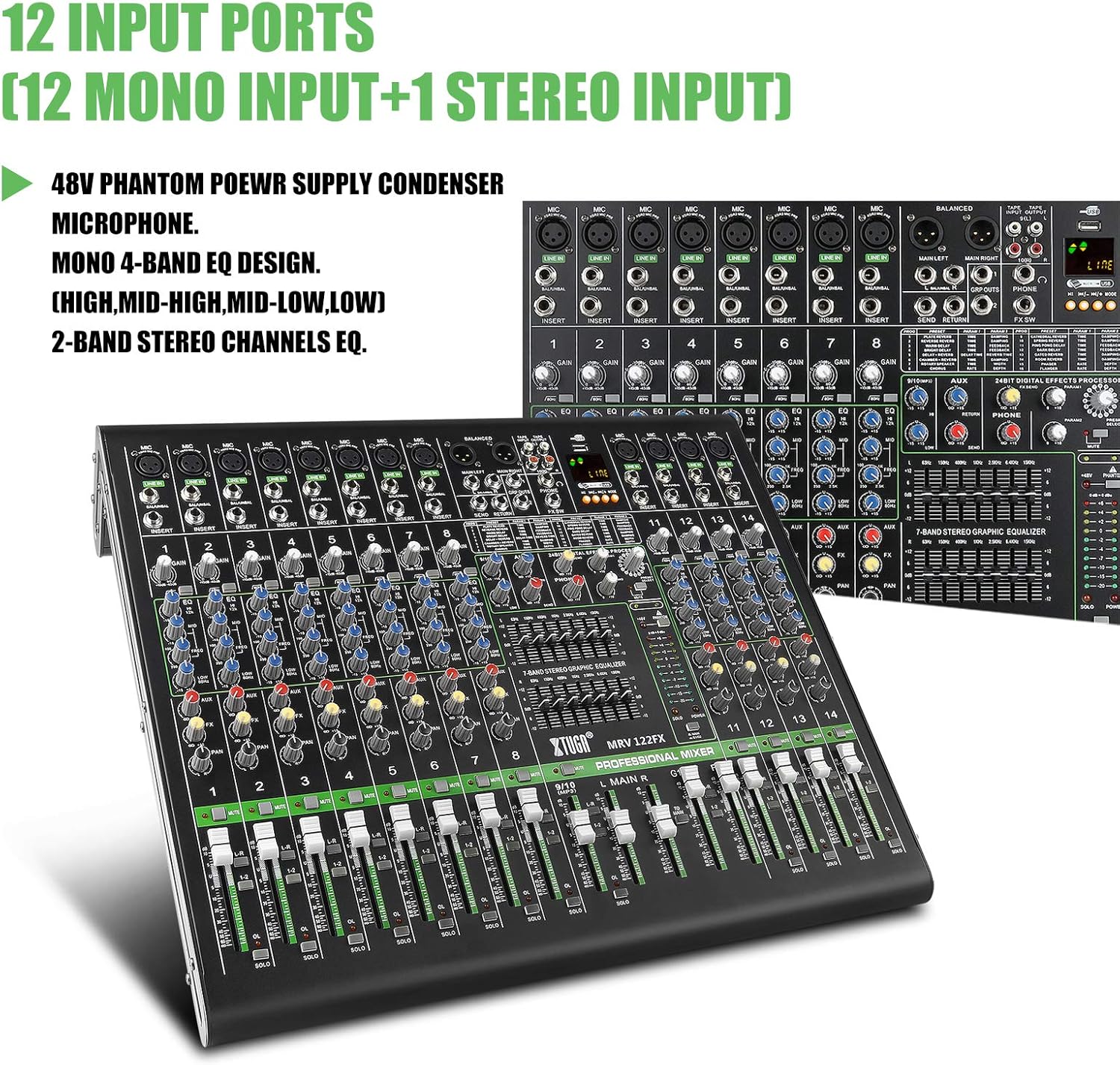
Image 3.2: Close-up of the mixer's input section, highlighting the 12 input ports (10 mono, 2 stereo).
- Mikrofoni: Connect dynamic or condenser microphones to the XLR inputs (channels 1-8). For condenser microphones, activate the +48V phantom power switch located near the master section.
- Apparati fil-Livell tal-Linja: Qabbad strumenti (tastieri, kitarri bi preamps), media players, or other line-level devices to the 1/4" TRS/TS LINE IN jacks on mono channels or the stereo LINE IN jacks on channels 9/10 and 11/12.
- Daħħal il-Punti: Channels 1-8 include 1/4" TRS insert jacks for connecting external signal processors (e.g., compressors, gates) to individual channels.
3.4 Konnessjoni tal-Outputs
- Riżultati Prinċipali: Connect your main PA system or recording interface to the MAIN L/R XLR or 1/4" TRS outputs.
- Ibgħat AUX: Use the AUX SEND 1/4" output to connect to stagmonitors elettroniċi jew proċessuri tal-effetti esterni.
- Headphones: Connect headphones to the PHONES 1/4" stereo jack for monitoring.
- Output USB: Connect the USB port to a computer for digital audio recording.
4. It-tħaddim tal-Mixer
4.1 Kontrolli tal-Kanal (Kanali Mono 1-8)
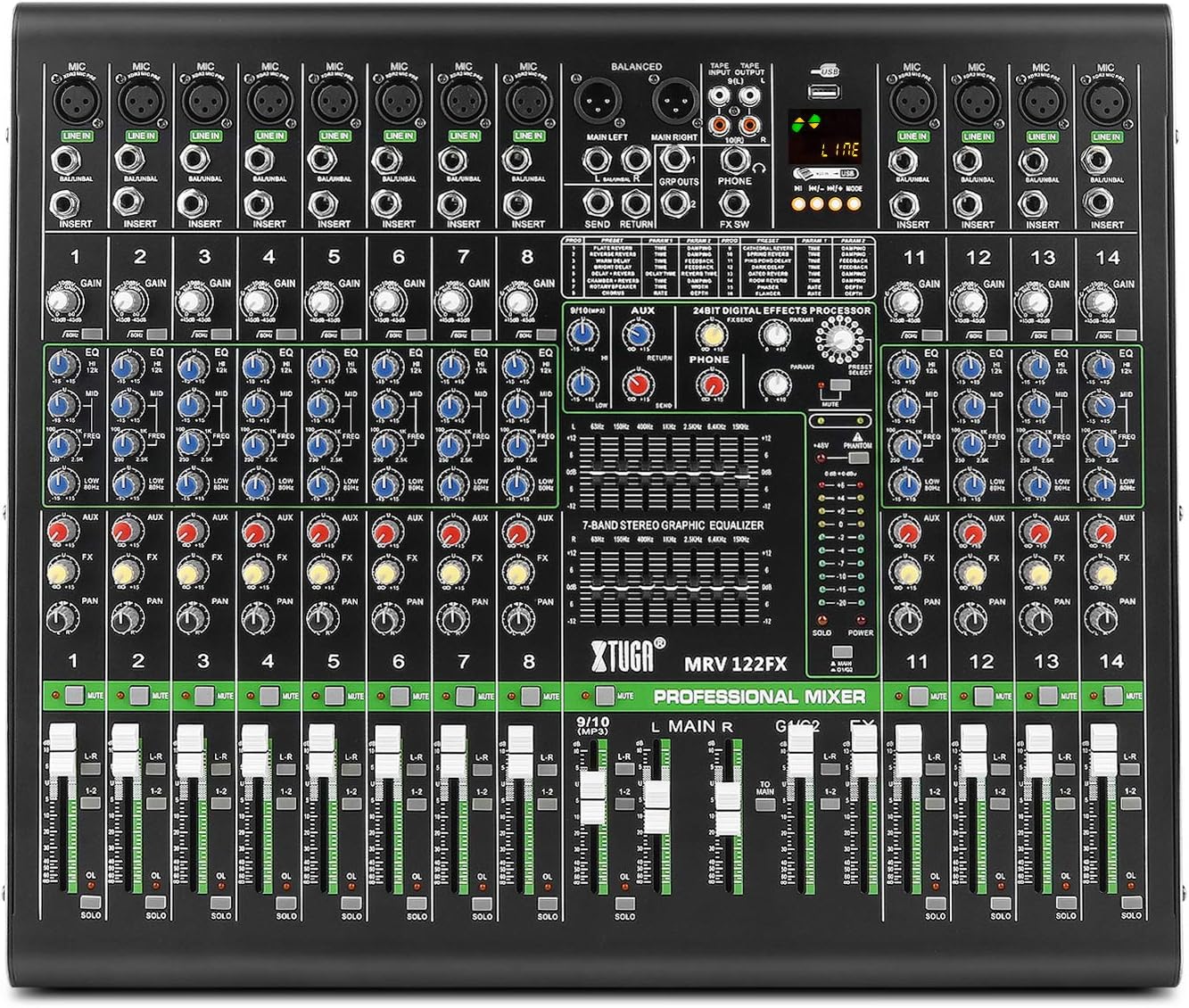
Immaġni 4.1: Dettaljata view of a single channel strip, showing Gain, EQ, Aux, FX, Pan, Mute, and Fader controls.
- QLIGĦ: Adjusts the input sensitivity for the microphone or line input. Set this to achieve a strong signal without clipping (the OL LED should flash only occasionally).
- EQ (High, Mid-high, Mid-low, Low): These four knobs allow you to shape the tone of the input signal. Adjust to enhance or cut specific frequencies.
- LO-CUT: Activates an 18dB/octave, 75Hz high-pass filter to remove unwanted low-frequency rumble.
- AUX: Controls the amount of channel signal sent to the AUX SEND output.
- FX: Controls the amount of channel signal sent to the internal effects processor.
- PAN: Jippożizzjona s-sinjal tal-kanal fil-kamp stereo (mix-xellug għal-lemin).
- MUTE: Jissikket il-kanal.
- SOLO: Routes the channel signal to the headphones for isolated monitoring without affecting the main mix.
- Fader tal-Kanal: Jaġġusta l-livell tal-volum ġenerali tal-kanal fit-taħlita prinċipali.
4.2 Stereo Channels (9/10 and 11/12)
These channels are designed for stereo line-level inputs. They typically feature 2-band EQ, AUX, FX, BALANCE (instead of PAN), MUTE, SOLO, and a channel fader.
4.3 Kontrolli tas-Sezzjoni Prinċipali
- MAIN L/R Faders: Ikkontrolla l-volum ġenerali tal-ħruġ tat-taħlita stereo prinċipali.
- RITORN AUX: Adjusts the level of the signal returning from an external effects processor connected to the AUX RETURN inputs.
- PHONES Level: Jikkontrolla l-volum tal-output tal-headphones.
- 7-Band Stereo Graphic Equalizer: This equalizer allows for fine-tuning the overall frequency response of the main mix. Adjust the sliders to boost or cut specific frequency bands.

Image 4.2: Close-up of the 7-band stereo graphic equalizer, showing frequency bands and boost/cut controls.
4.4 Digital Effects Processor (DSP)

Image 4.3: Section of the mixer highlighting the 24-bit digital effects processor with 16 modes.
- Buttuna tal-PROGRAMM: Rotate to select one of the 16 built-in DSP effects (e.g., Reverb, Delay, Chorus).
- Buttuna tal-PARAMETRU: Adjusts a specific parameter of the selected effect (e.g., decay time for reverb, delay time for delay).
- Livell FX: Controls the overall volume of the effects return into the main mix.
- TAPP TEMPO: For time-based effects like delay, press this button repeatedly to set the tempo.
4.5 Bluetooth, MP3/USB Playback and Recording

Image 4.4: Close-up of the digital display and multimedia control section, including USB and Bluetooth functionality.
- Bluetooth: Activate Bluetooth on your mobile device and search for the mixer. Pair with the device to stream audio wirelessly. Use the dedicated controls on the mixer to manage playback.
- MP3 (U-DISK) Playback: Insert a USB flash drive (U-DISK) containing MP3 files into the USB port. Use the digital display and control buttons to navigate and play tracks.
- Funzjoni REC: The mixer supports recording directly to a USB flash drive. Refer to the digital display interface for recording options.
- USB Computer Connection: Connect the mixer to a computer via USB to use it as an audio interface for recording or playback.
5. Manutenzjoni
To ensure the longevity and optimal performance of your XTUGA MRV122FX mixer, follow these maintenance guidelines:
- Tindif: Use a soft, dry cloth to clean the exterior of the mixer. Avoid using abrasive cleaners, solvents, or waxes, as these can damage the finish and controls.
- Protezzjoni mit-Trab: Keep the mixer covered when not in use to prevent dust and debris from accumulating on the controls and inside the chassis.
- Kundizzjonijiet Ambjentali: Operate and store the mixer in a cool, dry environment, away from direct sunlight, extreme temperatures, and high humidity.
- Sigurtà tal-Enerġija: Always disconnect the power cable before cleaning or if the unit will be unused for an extended period.
6 Issolvi l-problemi
If you encounter issues with your XTUGA MRV122FX mixer, refer to the following common problems and solutions:
- Ebda Ħsejjes tal-Ħsejjes:
- Iċċekkja l-konnessjonijiet kollha tal-enerġija u kun żgur li l-mixer huwa mixgħul.
- Verify that main faders and channel faders are raised.
- Ensure no MUTE buttons are active on channels or master.
- Iċċekkja l-konnessjonijiet tiegħek amplifier jew kelliema powered.
- Confirm input sources are active and sending a signal.
- Distortion or Unclear Sound:
- Reduce the GAIN on input channels if the OL (Overload) LED is constantly lit.
- Lower the main output faders if the main meters are consistently in the red.
- Check all cables for damage or improper connection.
- L-Enerġija Fantażma Ma Taħdimx:
- Ensure the +48V phantom power switch is engaged.
- Verify that condenser microphones are connected via XLR cables.
- Kwistjonijiet ta' Konnettività Bluetooth:
- Ensure Bluetooth is enabled on both the mixer and your device.
- Check that the mixer is in pairing mode.
- Move your device closer to the mixer to reduce interference.
- Digital Display Language (e.g., Chinese):
- Some units may default to a specific language. Check the digital display's menu options for a language setting. If no option is available, contact customer support for assistance.
7. Speċifikazzjonijiet
| Karatteristika | Speċifikazzjoni |
|---|---|
| Numru tal-Mudell | MRV122FX |
| Numru ta 'Kanali | 12 |
| Piż tal-oġġett | 8.89 kg |
| Dimensjonijiet tal-Prodott | 60 x 56 x 24 ċm |
| Teknoloġija tal-Konnettività | XLR, USB, Bluetooth |
| Sors tal-Enerġija | Corded Electric (100-240V) |
| Mic Input (Max) | 30dBu |
| Line Input (Max) | 21dBu |
| Mixer Rated Output (Main) | +4dBu |
| Frequency Response (Mic Input to Main Output) | +0-1 dB, <10Hz to 80KHz; +0-3 dB, <10Hz to 120KHz |
| EQ (each band) | ± 15dB |
| Proċessur tal-Effetti Diġitali | 24-bit, 16 FX settings |
8. Garanzija u Appoġġ
For warranty information, technical support, or service inquiries, please refer to the documentation provided with your purchase or contact your retailer. Keep your proof of purchase for any warranty claims.